.png)












In my early years as an architect, no one spoke about “change making”. What I did hear, far more often, were the familiar lines we all know too well: “Finish the drawing before the printer breaks.” “We need to submit by 3pm.”
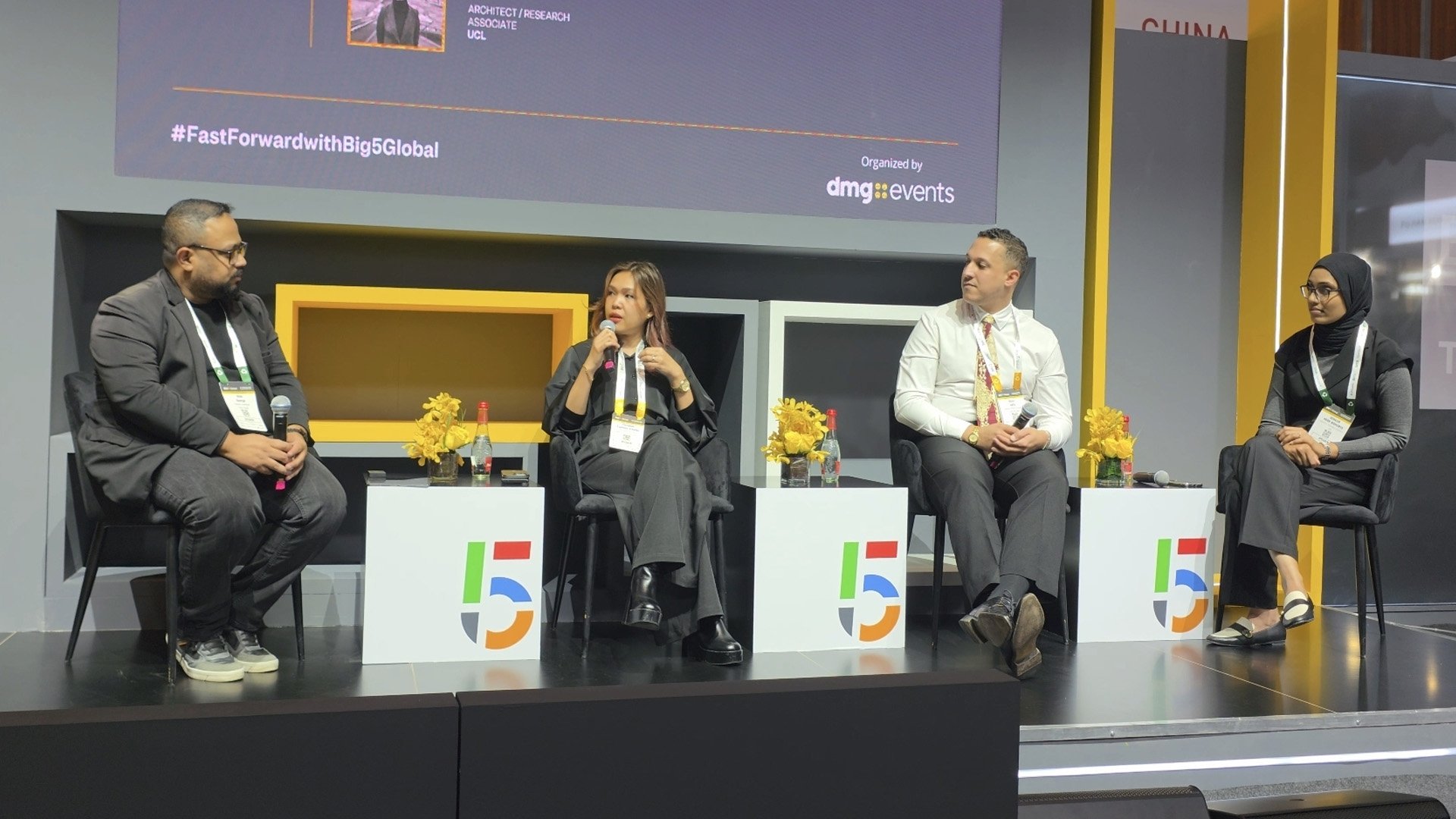
At that stage, being a change maker wasn’t even a concept. Surviving the deadline felt like the highest form of achievement. But sitting on the Big 5 Global panel at DWTC, looking out at a room filled with architects, engineers, students, and future leaders, I realised something essential: architecture is never neutral. Every line we draw either reinforces the status quo or nudges the world gently forward.
Seen through that lens, architect as change maker stops being a slogan. It becomes a responsibility. This reflection captures what we explored on the panel, what deserved to be said aloud, and what it means today to be an architect who doesn’t only shape spaces, but reshapes systems. An architect who builds with purpose, influence, and long-term value.
The Future of Buildings: Intuitive, Adaptive, Human
We opened with a deceptively familiar question: “What will future buildings look like?” Most of us can recite the usual answers, smart buildings, biophilic design, sustainable systems, advanced façades. But my thoughts went deeper.
For me, the future of architecture is not about how buildings look. It’s about how they adapt.
I imagine buildings that:
- Shift and flex with real patterns of living and working
- Are truly multi-functional, not simply “open plan with movable furniture”
- Use second skins and responsive façades that react to heat, light, climate
- Feel intuitive to navigate, where light, sound, temperature, and movement quietly guide you
The Architect as Maestro, Not Dictator
Everyone in that room knew the familiar scenario: you present a strong vision, and immediately someone says:
“Follow the AI image.”
“Can we fit more spaces within?”
“That column won’t work, remove.”
It’s the soundtrack of every design meeting. But if all we hear is friction, the vision evaporates quickly.
After nearly two decades in practice, I’ve come to believe something deeply: no meaningful building is ever built by one person. Collaboration is not a courtesy; it is the work.
The architect’s role is not to dominate, but to conduct, to bring clarity, intention, and direction so the collective performance elevates rather than dilutes the design… hold the vision steady while aligning the voices around it.
That means leadership in architecture is a constant balancing act:
- Listening seriously to technical constraints without surrendering too early
- Translating between creative and technical languages
- Knowing when to protect the idea, when to adapt it, and when to evolve it
A change-making architect doesn’t dominate the room. A change-making architect aligns the room. Leadership in design is not about control. It is about alignment. It’s reading the room, setting the tone, and guiding multidisciplinary voices towards a shared outcome that respects both vision and viability.
Because when done well, the result is not a compromise. It’s a symphony.
Vision vs. Time: When Projects Outlive Trends
Most architectural projects live on a timescale that outlasts trends. Buildings and masterplans take years, sometimes decades. Technology, policy, and culture can shift in under twelve months. So the panel asked: “How do you keep a vision alive when the world keeps changing?”
The answer depends entirely on the type of vision you hold. If the vision is aesthetic, a shape, a colour, a look, it will age quickly. But if the vision is value-driven, health, equity, climate resilience, cultural continuity, then new tools, new codes, and new expectations become assets, not threats. Regional frameworks like Vision 2030 and Dubai 2040 work similarly. They are not final drawings. They are directional compasses pointing towards liveable cities, human-centred public spaces, resilience, and diversification.
A strong architectural vision should be:
- Clear enough to guide decisions over 10–20 years
- Flexible enough to absorb new technologies and constraints
- Deep enough to matter long after the renders have stopped trending
That is how architecture stays relevant across time.
Architects and Policy: We Cannot Sit on the Sidelines
One question lingered with me long after the panel: “Should architects be involved in policy?” My answer remains yes, absolutely, and urgently. Architecture today is public health. Architecture is mobility. Architecture is climate resilience, cultural continuity, social behaviour, and community wellbeing. If our work influences all of these, then our voices must shape the policies that govern them. Calling architecture “just buildings” has never been less accurate.
- Shade, thermal comfort, and heat resilience
- Schools and hospitals as civic anchors
- Housing rooted in culture and identity
- Walkability, microclimates, people-first mobility
- Climate-responsive planning and net-zero frameworks
- Place-making that protects heritage while enabling growth
This shift is welcome, but there is a nuance I care deeply about: Policy cannot be written solely from inside a boardroom. To design systems that genuinely work, architects must listen first, to the people who live in, move through, and experience the spaces we shape. Residents who avoid certain plazas, workers who carve out unofficial routes planners never predicted, students who reshape school life through their lived behaviour, and families who intuitively understand comfort long before any guideline does. Their everyday patterns reveal what metrics often miss.
If we don’t understand human behaviour, our policies may look perfect on paper, and collapse the moment they meet real life. Architects bring something essential to policy: the ability to connect culture, climate, mobility, behaviour, heritage, and spatial design in one holistic view. We see how a small design decision becomes a decade-long consequence. This is why architects cannot stay on the sidelines. We are not just designers of buildings, we are shapers of systems, standards, and futures.
The Inner Qualities of a Change-Making Architect
The conversation then turned to the question I wish someone had asked me 2 decades back: “What qualities does an architect need to create genuine change?”
Here are the four I shared, and still believe in.
- Courage
Not theatrical courage. Quiet courage. The courage to question “how things are done,” engage in uncomfortable discussions, to challenge norms respectfully, and to stand by values when compromising feels faster or easier. - Clarity
If you cannot explain your idea clearly, it will be diluted until it no longer matters. Clarity is not a soft skill, it is leadership. Change-makers turn complex architectural and urban ideas into language others can understand, engage with, and support. - Cultural Intelligence
In the UAE and the wider region, context is not optional. It is the foundation. Respect for culture, faith, climate, memory, and social rhythms prevents the mistake of importing generic “global” solutions that erase identity. - Collaborative Literacy
Collaboration is more than willingness. It is literacy. The ability to meaningfully engage with other disciplines. Buildings that fail most dramatically often share one trait: they were designed in silos.
The Inner Qualities of a Change-Making Architect
Towards the end, we spoke about legacy, a topic architects love to intellectualise. But after 21 years in practice, I’ve realised something simple: my legacy will never be a single building. Yes, Godwin Austen Johnson has projects like the Jafar Centre at Dubai College , a building whose performance, sustainability, and design have earned international recognition.
But the moments that stay with me are far quieter. They come from the students who use the building every day, telling us they feel better in the space, that absenteeism has dropped, that studying somehow feels easier, and that the building itself made them consider architecture as a future profession. A small, intentional building quietly shaping young minds: that, to me, is legacy. For me, architectural legacy is far deeper than a completed building. It looks like projects that quietly improve lives long after the opening ceremony, spaces that enhance wellbeing, support learning, and positively shape everyday behaviour. It’s the young architects who grow into confident professionals through mentorship, guidance, and real project exposure. And it’s the memories created, the conversations that shift someone’s path, and the students or visitors who decide to pursue architecture because one moment sparked something meaningful. In the end, a true legacy in architecture is not just built form; it is the long-term human impact we leave behind. Buildings are only the vessel. The true legacy lives in the behaviours they shape, the choices they enable, and the futures they unlock, impact carried forward by people.
One sentence for the next generation
The final question “ What advice would you give young architects now?” Here is mine: Find a mentor, and then become one.
When I began, there were very few visible architects I could reach out to, especially women. Today, those barriers no longer exist. The industry is more open, accessible, and generous than ever, so reach out, ask thoughtful questions, listen far more than you speak, and be honest about what you don’t yet know. Those simple acts accelerate growth in ways no textbook ever can. And when you rise, turn around and hold the ladder for someone else. Because in the end, our true legacy as architects is not just the skyline we leave behind. It is the people we lift and the quality of lives we improve as we build it.
If any part of this resonates with you, the listener, the challenger, the collaborator, the mentor, then yes, you are already a change maker. The next step is to act like one, consistently, project after project, conversation after conversation. Because cities don’t change overnight. They change every time someone in our profession decides that “good enough” is no longer good enough.